
It’s the first week of fall semester. The lots are full by 7:45 a.m. A contractor’s truck sits in a faculty space. A student with a Zone C permit parks in Zone A because “it was empty.” Campus police get three calls before 9 a.m., and nobody can find the guest who needs to be in the provost’s office by ten. This is what happens when a campus runs parking on instinct instead of a system.
College and university Campus parking administrators manage one of the most logistically complex environments in local institutional operations. Building a campus parking permit program that actually works requires more than printing passes and assigning spaces. The population of parking permit users changes every semester, demand spikes and drops unpredictably, and users range from tenured faculty with thirty years on campus to first-day commuter students.
The numbers reflect that complexity. Total postsecondary enrollment in the United States reached 15.3 million undergraduate students in Spring 2025 — a 3.5% increase over the prior year, according to the National Student Clearinghouse Research Center.* More students mean more vehicles. More vehicles mean more pressure on permit systems, enforcement staff, and available space — especially at institutions that have not expanded their parking infrastructure to match enrollment growth.
For many campuses, this can cause daily complications and a repeated cycle of unauthorized parking and even complaints. The parking process is not only about the lots, the cars, the students and faculty -it starts well before that. A cohesive program that considers daily volume, a full view of the parking facilities (lots/garages), user needs, administration needs, enforcement needs – and more – may seem simple – just print some permits and hand them out – but first there’s many considerations and decisions needed in advance of getting the permit designed. Considerations include – who can park where, and when, what’s the overall policy for parking in general, will fines be levied for unauthorized parking, and how to get the permits to the users in the first place.
A university campus parking permit program can break down early in the process when administrators try to manage demand without first mapping supply. The right starting point is one of the most basic steps that can be taken – reviewing the physical lots and parking structures that exist on campus, and understanding how parking works today.
Divide your parking inventory into zones based on proximity to core academic buildings and the realistic walking tolerance of each user group.
A workable starting framework for most mid-size to large campuses looks like this:
The number of zones you need depends on your campus footprint and population mix.
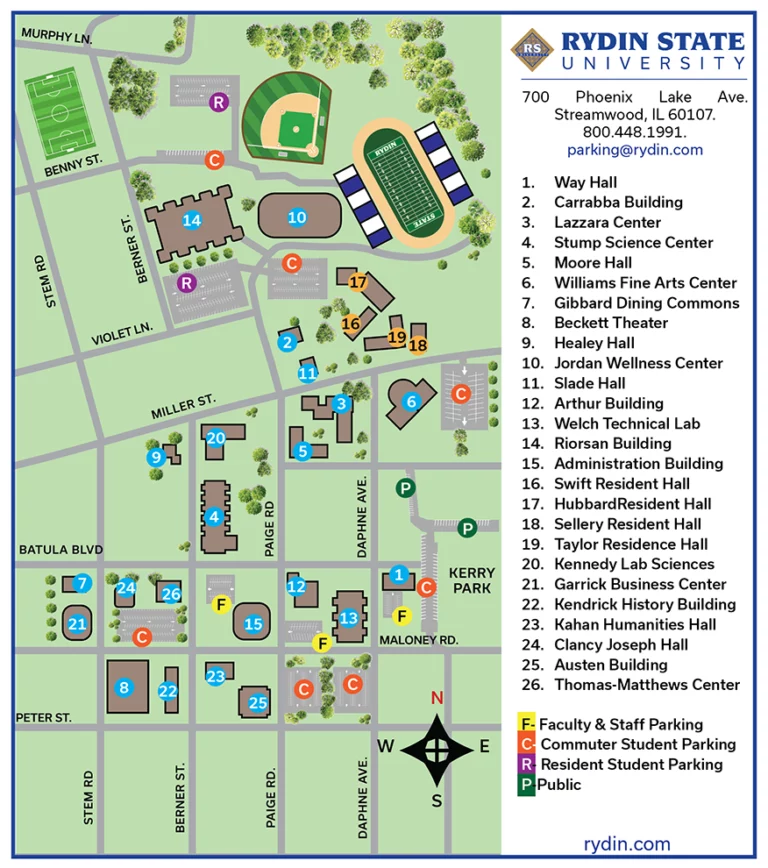
Once zones exist, build your permit structure around the actual user classes on your campus. Standard categories for a college campus parking permit program can include:
A good best practice is to review your permit categories yearly in advance of ordering next year’s supply. Campuses that have not revisited their permit structure in five or more years almost always carry legacy categories that no longer reflect how people actually arrive and park.
Zone structure and user categories define who parks where. The physical permit is what makes the campus parking permit program visible and enforceable in the field — it provides authorization to the user and a verification point for enforcement staff.
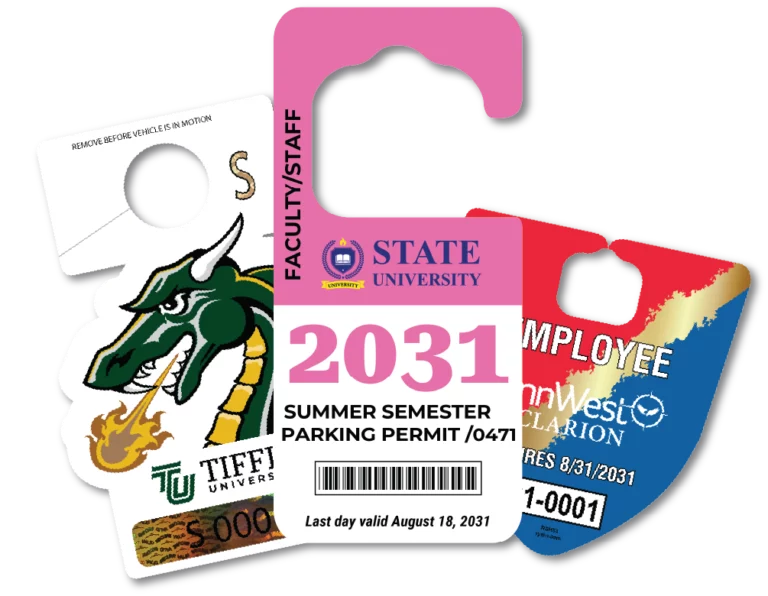
Parking permit hang tags work well for the majority of campus permit categories because they are highly visible to enforcement staff from a distance and can accommodate various security features.
Hang tags – based on policy, can be transferrable – or feature data that ties the permit to a specific vehicle. Transferability can be useful for faculty and staff who drive multiple vehicles. Adding Color-coding by zone lets enforcement officers identify authorization at a glance without running a plate. Sequential numbering, ties each tag to a specific permit record, which supports both enforcement and loss tracking. Features such as holograms, barcodes, and reflective treatments both aid enforcement teams, and protect against counterfeiting.
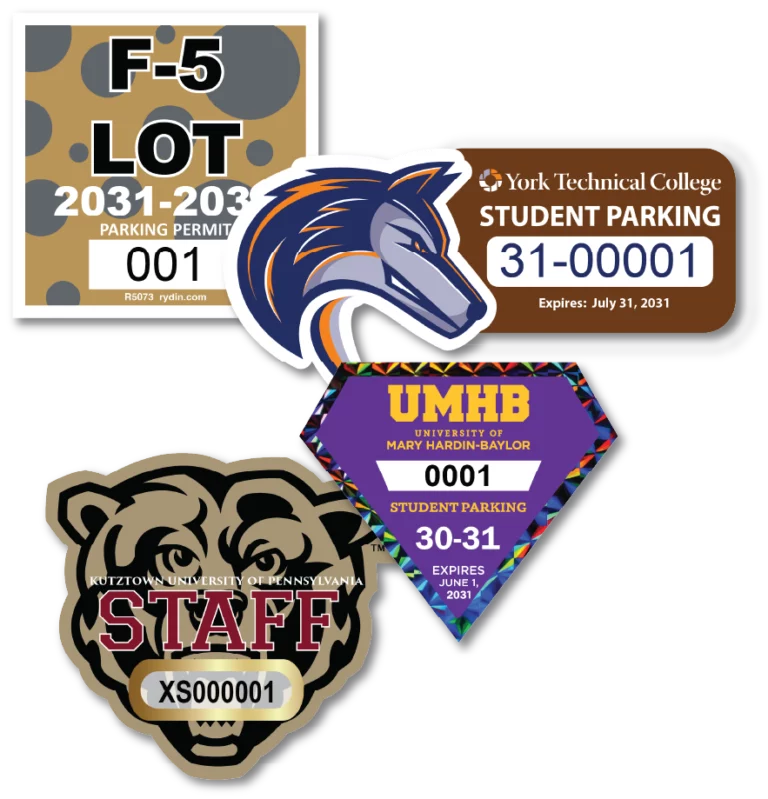
Parking decals attach directly to the windshield or bumper and stay with one vehicle. That specificity makes them the right choice for permit programs where sharing or transferring authorization is a violation — residential student permits, for example, or high-security faculty reserved spaces.
Because a decal cannot be removed cleanly, it discourages the kind of permit sharing that erodes compliance on every campus. To guard against removal, material options can be choses – such as Void Polyester that indicate tampering when removal is detected are a smart choice. This makes reuse impossible and counterfeiting significantly harder. For campuses managing large resident populations or high-value reserved zones, decals provide a high level of control. Much like hang tags decals can feature other anticounterfeit and enforcement features such as holograms, reflective coatings, barcodes and variable data.
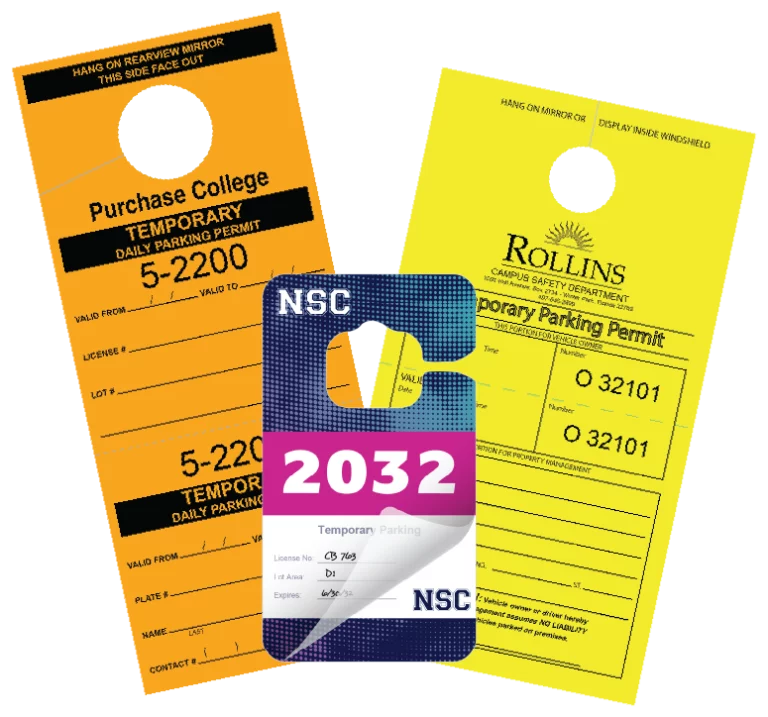
Temporary permits cover the visitors, contractors, visiting faculty, and event guests who legitimately need campus access without a permanent credential. The key design principle here: make temporary access easy to obtain through authorized channels, and hard to abuse.
A department-sponsored guest pass system — where the host department initiates the request and receives the pass — distributes the administrative load and creates accountability. Day passes printed with a specific date and sequential number are harder to reuse than generic passes. Paper temporary passes with a void pattern or security feature add another layer of enforcement support without adding cost.
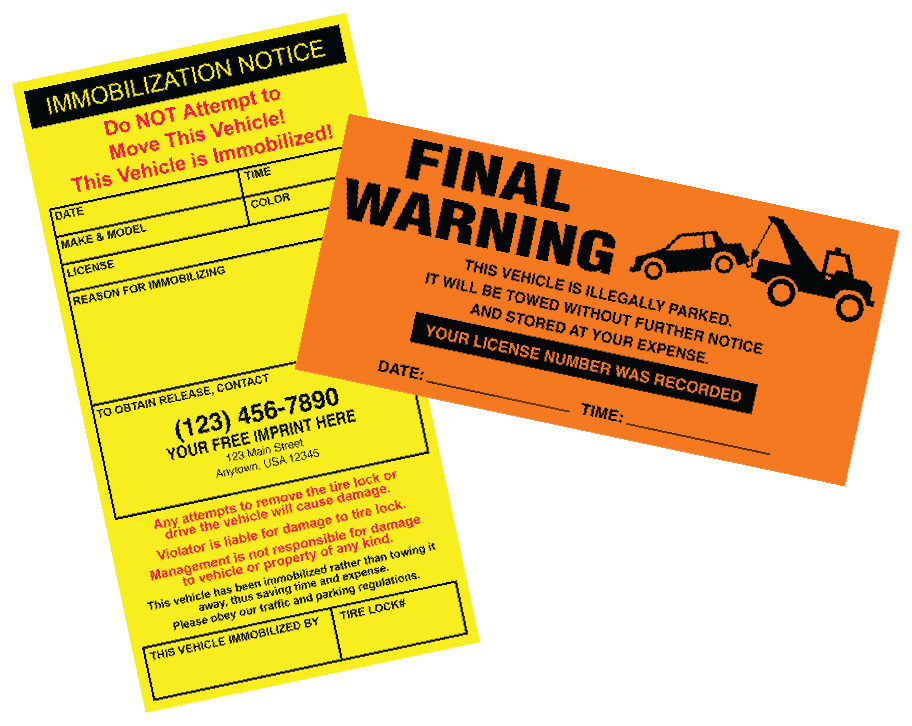
Parking enforcement decals —warning stickers and violation notices serve a function that written citations alone do not. They make enforcement visible. A vehicle that returns to campus with warning decal on the driver’s side window sends a message to every driver in that lot. Consistent use of enforcement decals builds the kind of compliance culture that reduces citation volume over time, because drivers learn that violations have consequences.
A campus parking permit program is only as effective as its enforcement. The permits can be perfectly designed, the zones logically structured, and the policy clearly communicated — and none of it matters if enforcement is inconsistent or under-resourced. Developing a consistent college campus parking permit enforcement process assures compliance.
Parking enforcement decals —warning stickers and violation notices serve a function that written citations alone do not. They make enforcement visible. A vehicle that returns to campus with warning decal on the driver’s side window sends a message to every driver in that lot. Consistent use of enforcement decals builds the kind of compliance culture that reduces citation volume over time, because drivers learn that violations have consequences.
Enforcement coverage needs to be consistent and varied. If the entire campus knows that officers only patrol Zone A between 8 and 10 a.m. on weekdays, every other zone at every other hour becomes a de facto free-for-all. Rotate patrol schedules. Include evenings and events. Prioritize fire lanes and accessible spaces on every shift — those violations carry legal weight, not just policy weight.
Physical permits and enforcement decals solve the visibility problem. Rydin PermitExpress (RPE) solves the data problem. RPE is a web-based permit management platform that connects permit issuance, distribution, and enforcement into one system — with mobile enforcement tools that let officers verify permits and issue citations in the field without returning to a desk.
For campuses managing thousands of permits across multiple zones and user classes, that kind of real-time data connection is the difference between enforcement that works and enforcement that generates appeals and administrative rework. Read more about how RPE supports campus operations in Rethinking Campus Parking Management
Redesigning a campus parking permit program sounds like a multi-year project that requires headcount you don’t have. In practice, the inverse is true — a well-structured program reduces the staff burden of managing parking, because it eliminates the manual work that fills hours today.
A permit program that is clear and consistently enforced generates fewer appeals. A physical permit format that enforcement officers can verify at a glance reduces the time spent running plates and pulling records. A distribution process that routes permits directly to departments or residential halls — rather than requiring staff to manage in-person pickup windows — scales without adding staff.
The upfront investment in program design and the right permit materials pays back in reduced administrative time within the first full academic year. The campuses that delay that investment because they are too busy managing the current chaos are the ones that spend every semester catching up. Like the deep details on what goes into to developing the perfect permit and what materials to use. Check out materials blogs for Hang Tags, and Decals.
Budget is a real constraint for most elementary schools, and it’s one of
Rydin has manufactured parking permits, hang tags, and enforcement credentials for college and university campuses since 1956. Every product is made in the USA, at Rydin’s Streamwood, Illinois facility — which means consistent quality, reliable lead times, and no reseller markup between the manufacturer and your department.
Parking frustration on campus is not inevitable — it is the result of programs that grew reactively instead of being designed intentionally. The campuses that control their parking successfully share a common starting point: a clear zone structure, a logical permit catalog, physical credentials that support enforcement, and a consistent policy that everyone on campus knows is real.
If you are ready to build that program — or modernize the one you have — Rydin is a good place to start.
Step 1 — Map Your Lots and Zones
Step 2 — Define Your Permit Categories
Step 3 — Choose the Right Permit Format
Step 4 — Build Your Enforcement Program
The right permit format depends on the user class and enforcement model. Hang tags work well for faculty and staff who drive multiple vehicles, because they are transferable and highly visible to enforcement officers. Decals are better suited for residential students or reserved spaces where vehicle-specific control is required. Most campuses run both formats simultaneously — hang tags for general permit categories and decals for high-security or residential zones.
Start by mapping your parking inventory to your actual user groups, not just geography. Identify which lots are closest to core academic buildings, which serve residential housing, and which work best for commuter students who can walk or use a shuttle. Assign permit categories to zones based on proximity, cost, and access level. Review and adjust the structure annually — campus enrollment patterns and space availability change, and your zone map should reflect current conditions.
Effective campus parking enforcement combines physical permit visibility with consistent patrol coverage. Enforcement officers verify permits — hang tags, decals, or virtual credentials — and issue citations for zone violations, expired permits, and unauthorized access. Enforcement decals, including boot warnings and violation stickers, make consequences visible to all drivers in a lot. Connecting enforcement tools to a permit management system like Rydin PermitExpress lets officers verify credentials in real time, which reduces errors and citation appeals.
A permanent campus parking permit covers a defined period — typically a full academic year or semester — and assigns the holder to a specific zone or lot. A temporary permit covers short-term or one-time access needs: visiting scholars, contractors, event guests, or students with a medical accommodation. Temporary permits should carry a specific expiration date, tie to an authorizing department, and use a format — such as a dated day pass or sequentially numbered paper pass — that cannot easily be reused or shared.
The right number of zones depends on campus size, population mix, and lot geography. Small campuses with a compact footprint may function well with two or three zones. Mid-size commuter campuses often need four to five, separating faculty, staff, commuter students, residential students, and visitors. Large research universities with dispersed buildings may use six or more zones with sub-categories. The goal is a structure that enforcement officers can apply quickly in the field — too many zones create confusion, too few create inequity.
Physical permits and digital management are not mutually exclusive — and for most campuses, the right answer is both. Physical hang tags and decals give enforcement officers immediate visual verification in any condition, without technology dependence in the field. A digital management platform like Rydin PermitExpress adds online issuance, waitlist management, real-time data, and mobile enforcement tools on top of that physical foundation. Campuses managing more than a few hundred permits, or running permit distribution across multiple departments or residential halls, benefit from a digital system regardless of whether they retain physical credentials.
Effective college parking management at a mid-size institution typically combines three elements: a clear zone structure with defined permit categories for each user group, physical permits — hang tags and decals — that enforcement staff can verify at a glance, and a consistent enforcement policy applied across all lots and schedules. Mid-size campuses often have enough complexity to need four or five zones and multiple permit types, but enough flexibility to implement changes without the multi-year timelines that larger universities face. The most common gap is enforcement — programs that are well-designed on paper but under-enforced in the field quickly lose compliance across the entire campus population.
Sources
