
E-bikes and e-scooters have become part of everyday transportation on campuses, in downtown districts, residential communities, and public spaces. Some can travel at 20 mph or more, putting faster-moving vehicles into spaces shared with pedestrians and traditional bicycles. Organizations are also dealing with crowded bike racks, charging concerns, and the need for policies that address where and how e-bikes can be used.
For campuses, municipalities, and other organizations managing shared spaces, creating an e-bike policy is only the first step. Once you decide to permit e-bikes, there’s another practical question:
How are you going to issue and manage hundreds or thousands of physical permits?
A well-designed e-bike permit program needs more than a registration form. Permits have to be produced, personalized, distributed, replaced, and tracked. The permit itself also needs to be durable enough for outdoor use and visible enough for staff to identify quickly.
Here’s what to consider when setting up an e-bike permit program, including the physical permit and the fulfillment process behind it.
Before you issue permits, establish the rules your permit program will support. Start with the basics:
The exact requirements will vary by organization and location. A university campus may have different considerations from a municipality managing public property, while a residential community may focus primarily on parking and charging. Once those rules are established, the permit becomes the physical representation of the program.
An e-bike permit needs to be easy to identify, durable enough for its environment, and tied to the information in your registration system.
The physical decal should give staff a quick way to determine whether a bike has been permitted. Depending on your program, it may also need to identify the permit holder, registration number, expiration date, or other information.
When choosing an e-bike permit decal, consider:
The design should also account for where the decal will be placed. E-bike frames come in a wide range of shapes and finishes, so a permit designed for a traditional vehicle windshield or bumper may not be the right solution.
A custom e-bike permit can give your organization the flexibility to incorporate its branding, numbering system, security features, and program requirements into one physical permit.
E-Bike & Scooter Permit Decals
Weatherproof, tamper-evident decals made for curved bike and scooter frames. Available in two standard sizes or a custom size, with numbering, barcodes and reflective options.
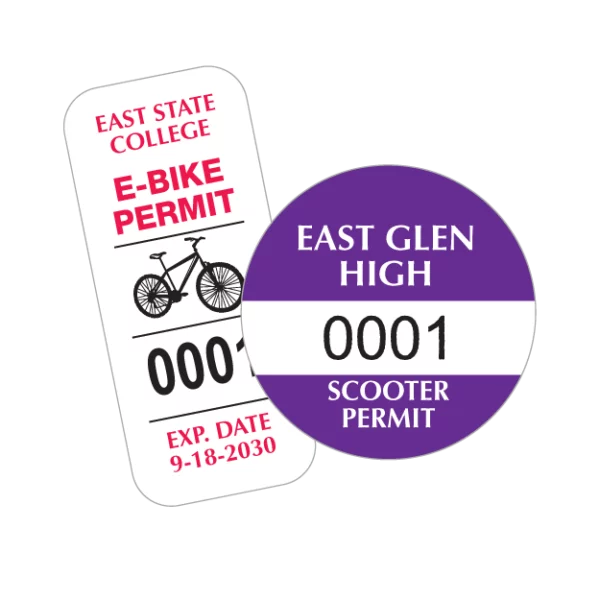
This is where an e-bike permit program can become an administrative project of its own.
Imagine a campus issuing 2,000 permits. Or a municipality managing several thousand registrations across multiple facilities.
Someone has to:
If your staff are printing labels, sorting permits, stuffing envelopes, and maintaining spreadsheets every time someone registers, the administrative work can quickly become disproportionate to the program itself.
A permit fulfillment partner can take those physical production and distribution tasks off your team’s plate.
Rydin provides custom permit production and fulfillment services for organizations managing permit programs at different scales. Permits can be produced with variable information, numbering, barcodes, and security features, then packaged and distributed according to your requirements.
For organizations with multiple locations or large permit volumes, fulfillment can also be structured around the way your program actually operates, whether that means shipping permits in bulk to a central office, distributing directly to permit holders, or supporting ongoing replacement and reordering.
The physical permit is what people see. Your registration system is what keeps the program organized.
Each permit should have a unique identifier that connects it to the appropriate registration record. That could be a sequential number, barcode, QR code, or another identifier appropriate to your system.
This gives staff a way to connect what’s physically displayed on the bike with the information held in the organization’s records.
This could be managed with a simple Google Form to allow riders to register online. This is an easy way to eliminate office line-ups and capture rider information for e-bike permit distribution.
For larger programs, the connection becomes especially important when permits need to be replaced, renewed, or audited. A unique permit number can help staff determine whether a permit is current and whether it belongs to the appropriate registration record.
Rydin’s PermitExpress® platform connects registration with physical permit fulfillment and mobile enforcement, giving organizations a way to manage permit records and physical permits through one system.
The result is a more manageable process from registration through permit distribution and field verification.
E-bike programs are ongoing. People lose permits. Bikes get replaced. Students graduate, employees leave, residents move, and new riders enter the program. Your permit process should account for those changes from the beginning. Consider:
A fulfillment process designed around those recurring needs can save staff from rebuilding the process every time the program changes.
Creating an e-bike policy is one part of the process. Turning that policy into a functioning permit program requires a reliable way to produce and distribute the physical permits.
From custom decal design and security features to numbering, packaging, fulfillment, and ongoing replacement, Rydin can help manage the physical side of your permit program.
Request a sample kit from Rydin to explore your options for materials, design, numbering, and security features.
For larger programs that need registration, permit production, fulfillment, and distribution support, talk to a Rydin specialist about how we can help manage your e-bike permit program.
